This blog celebrates “River Tours: the Avon” while reflecting on what might come next: a more locally rooted, ecologically imaginative creative journey that gives voice to the river herself and the more-than-human life she sustains.
Did you catch the tufted-textile mapped, performance-based event called “River Tours: the Avon” at various locations over the summer? If you didn’t, you missed a treat!
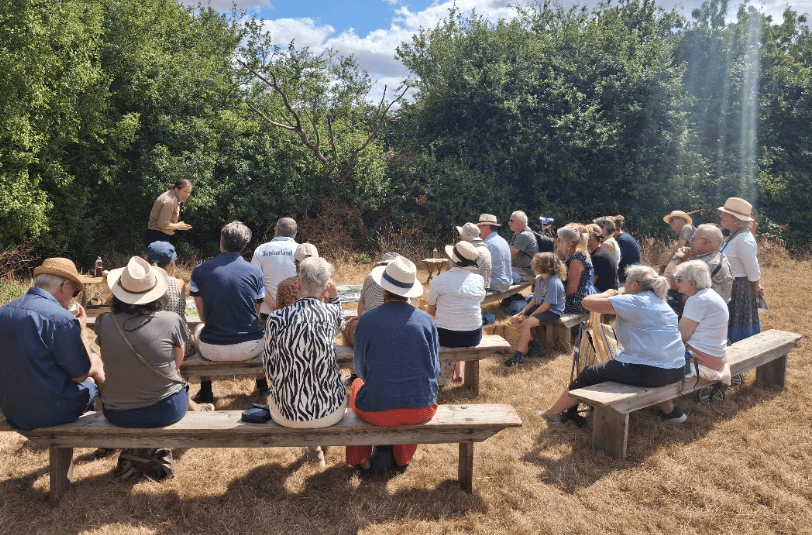
I attended the event in Hampton Lucy on Sunday 9 August. On a warm afternoon, I sat with fellow locals under shady trees immersed in a poetic and playful theatrical performance about the nearby river, woven with stories of humans and more-than-humans, delivered with wit and thoughtful musings, and enveloped in love of place. Other performances took place over the summer in Cherington, Shottery, Bidford-on-Avon, Pershore, Stratford-Upon-Avon, Luddington, Tewkesbury and Birmingham.
About River Tours – the Avon:
Created by Birmingham-based Stans Café Theatre Company, this hour-long piece of storytelling traces the flow of the River Avon from its source in Naseby to its confluence with the River Severn at Tewkesbury. The script is written by Craig Stephens (Associate Director of Stans Cafe). This is the latest part in the River Tours series which has already covered seven other rivers: the Thames, Lune and the Severn in England, as well as the Volga, Indus, Niger and Daugava.
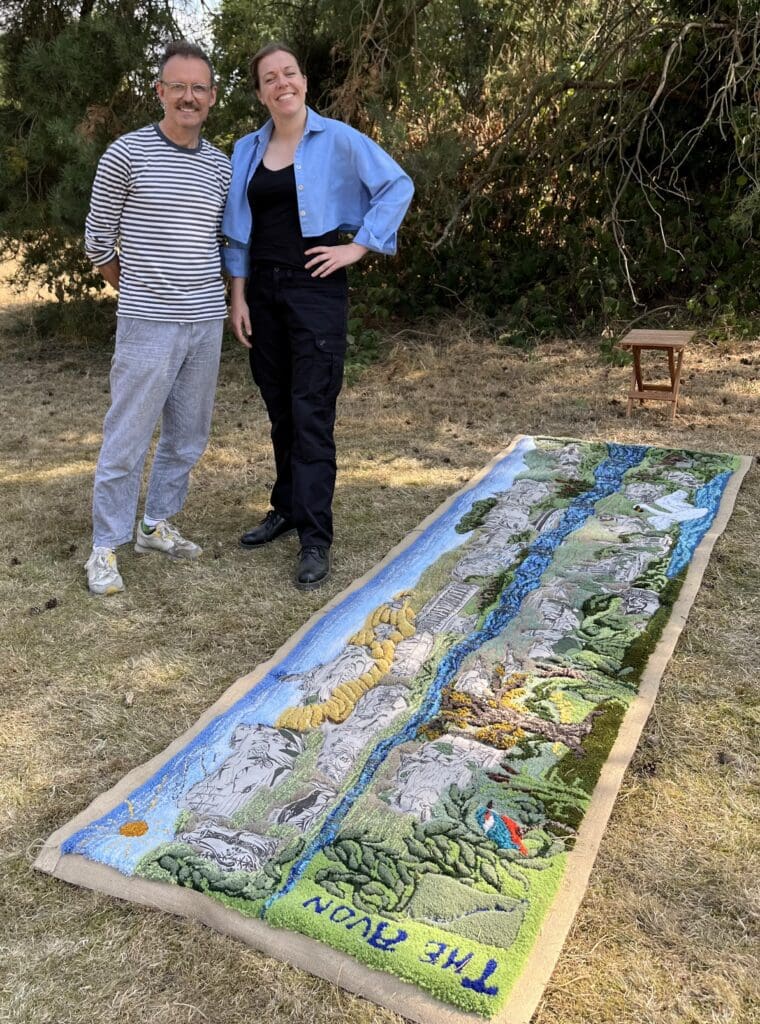
Actress Kathryn Hanke was our friendly guide, leading us along a tapestry river map, through centuries of human history, folklore and wildlife. She conjures up a verbal and visual journey where remarkable characters are encountered, unexpected stories uncovered and everyday river life moments revealed.
The River Avon tapestry map was created by Studio MEAD artists Ellie Carr-Smith and Molly Acacia Hughes. It will soon be displayed locally – location to be determined.
It is wonderful to see this project realised, thanks to Stans Cafe’s partnerships with Live and Local, the Royal Shakespeare Company, Arts Council England, Living Wage UK and the Garfield Weston Foundation. Stans Cafe had approached River Hope last year for possible collaboration. However, we felt that a templated project, initiated and implemented by a Birmingham-based company outside our District, didn’t align with our local attempts to catalyse grassroots creatives in water, Nature and river-themed work, so instead we put them in touch with Brook Arts Hub in Shottery, which clearly worked out well.
Although not directly involved in the process to production, River Hope had conversations with the Stans Café team that influenced the script, particularly the ending: “And at our journeys end let us hope this stretch of water will continue to flow through our lives and that we can quietly watch and listen and let her be what she has always been … the River Avon”.
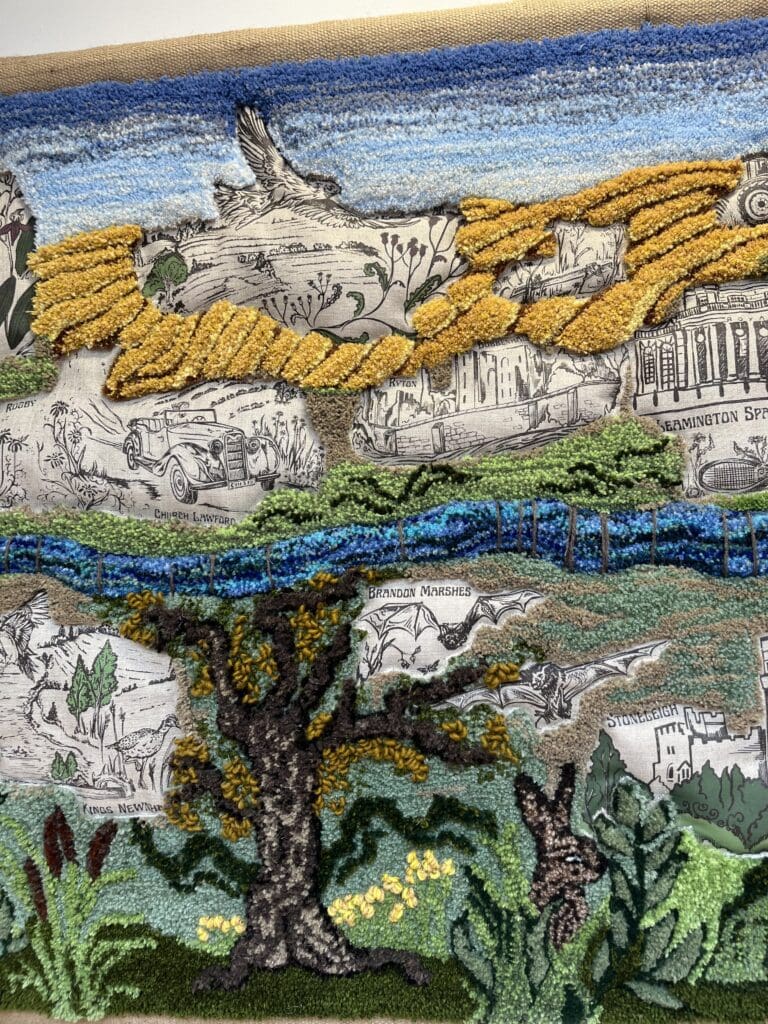
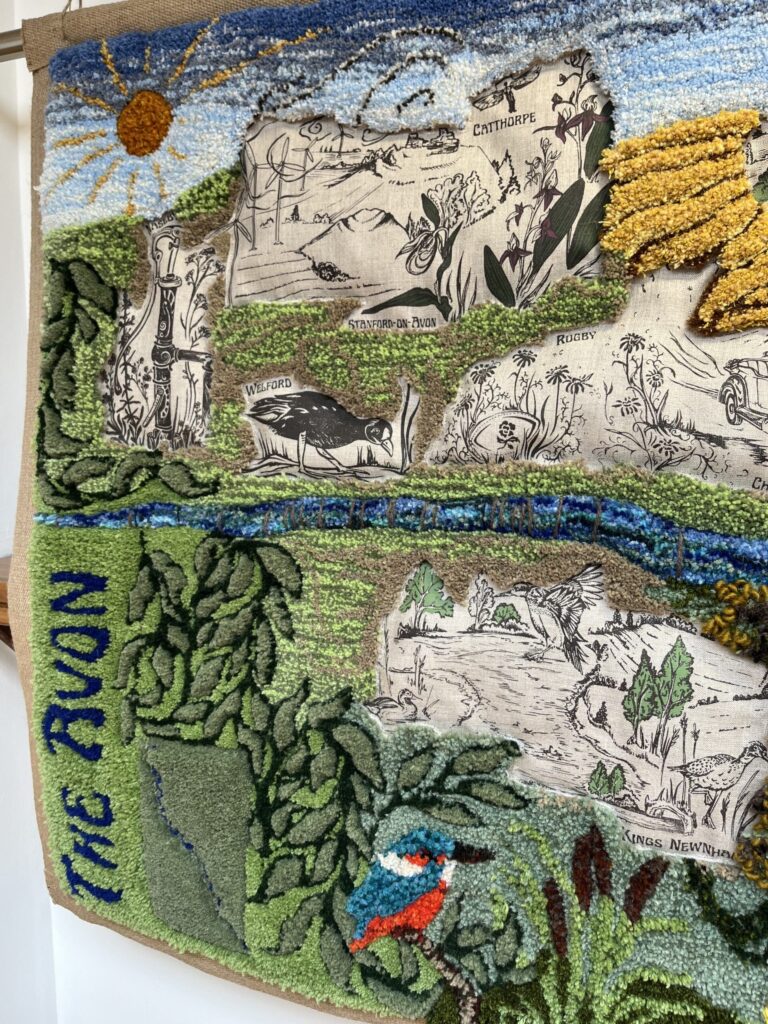
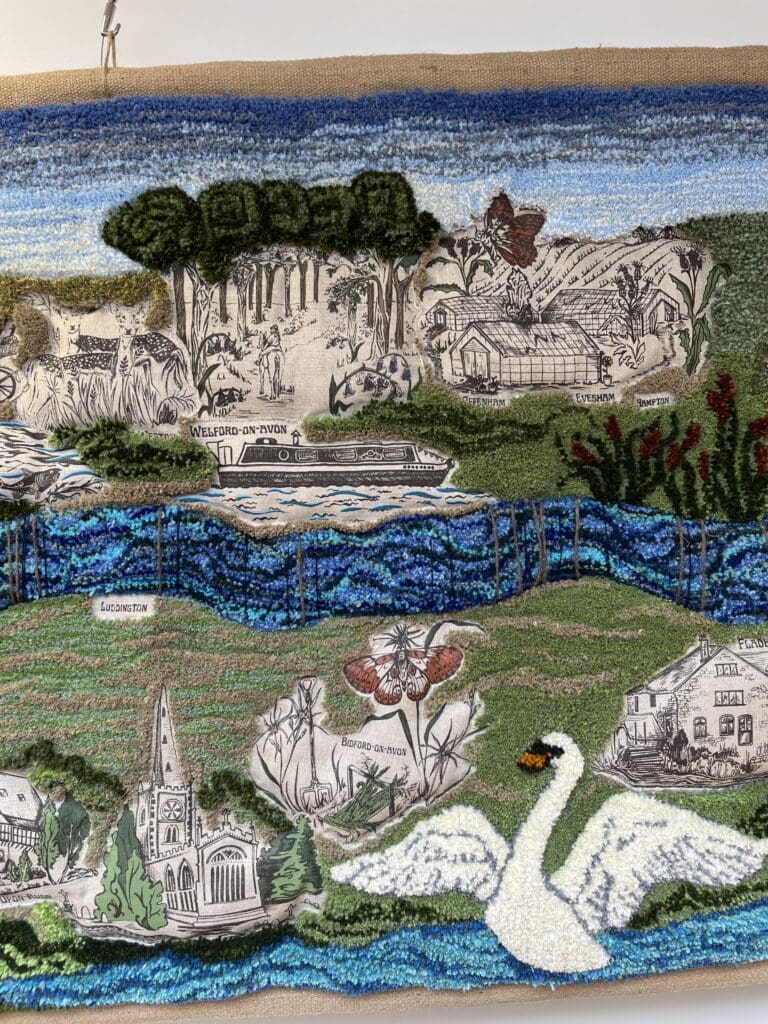
Details of the tapestry by Ellie Carr-Smith and Molly Acacia Hughes. Photos by Mary Manandhar
River Hope reflections:
“River Tours: the Avon” tells the story of the river as she runs her course through landscape and time. We experience this through the eyes of the human-created infrastructure, settlements, agriculture, trade, navigation, warfare, industry and leisure for which the river has been, and is still being, used. The anecdote stream is lively and engaging, full of humour, tease and irony.
There are vignettes of battles and trebuchets, kings and lords, transport, bridges, locks, mills, ferries, boaters, swimmers and anglers, all showing how the Avon has carried centuries of human ambition, expansion, work and play.
But there’s so much more besides.
The performance reaches beyond human history into Earth’s deep geological time: the water came first, humans came much later, and the river belongs to a far older story of seas, limestone, hidden springs and water’s ebb and returning flow. We are reminded that the river relates to all the water that has ever been, passing through the water cycle, “diluted with other waters, remixed and begins her story again”.
We hear about the disappeared waters, like the Sherbourne in Coventry, and the river in its many states of transformation as flood and freeze-over. We understand how so many local place names have their origin in the watery landscapes which allowed early settlements to establish and thrive. Flora and wildlife of all kinds – waterborne, airborne, rooted, crawling, winged, finned – appear along the journey, often accompanied by droplets of Shakespeare quotes creating ripples of recognition from the audience.
Interwoven throughout are today’s pressures and risks and future threats: poor ecological health, sewage spillages, agricultural and road run-off, litter, disturbance, declining species diversity, drought, flooding, intensive agriculture and water extraction.
Word choice is particularly appreciated. Sometimes in the performance the river and tributaries are called “she” and “her” rather than “it’ and ‘the”. The writer Robert Macfarlane refers to “the river who” in his book “Is a river alive?” as highlighted at his appearance for the launch of River Hope’s “The Gathering: for water and Nature” in March, in collaboration with the Stratford Literary Festival. But sometimes the more common expression “our river” appears – but is this “our” in the sense of being in relationship with, or “our” in the sense of ownership as property, asset, resource or amenity? Hopefully more the former.
We are encouraged to remember that water is not only outside us but also within: “the hidden currents inside us – filtering and lubricating, aiding digestion, keeping skin healthy. Every sip keeping the river of life flowing.”
What next?
River Hope is happy to amplify this work because we believe that creative expression can help us remember that humans are part of Nature, that we are largely water and that we are all intimately connected with water ecosystems in which we live. In these times of crises of Nature loss and human-induced climate change, everyone can be inspired, engaged, informed and ultimately act. For this, we will need to pull by emotions and heart as well as rationally push by the head with data and regulations towards creative, moral, legal and political imagination to better value and restore water, soil, air and the whole web of life on which we humans will always depend.
“River Tours: the Avon” has taken a predominantly anthropocentric view of the river and how it has shaped human history, economy, society, landscape use, leisure and culture. This has real value, and many will have enjoyed the performance, learnt something new and, hopefully, feel moved to act.
But it is also time to hear the voice of the river herself, and of the more-than-human life for whom the river ecosystem is home. Methods such as the Interspecies Council, brought to “The Gathering: for water and Nature” on March 15th at the Crowne Plaza Hotel in Stratford by Phoebe Tickell of Moral Imaginations, can help us listen and respond differently.
River Hope creatives are now exploring sensory and creative activities, including artistic ecological maps, focused on the perspective and voice of the river herself, rather than human-focused stories about the use and enjoyment of her.
The River Tours script says: “maps not only tell us where to go but also show us where we’ve come from, what was known, what mattered, how we understood the world“.
What new local water place maps can we imagine? A locally researched ecological map of the Avon bioregion could imagine what the river and her more-than-human inhabitants make of their own journeys through time in these landscapes. What stories would they tell, and what would they ask of us in these times as human stewards of clean water and thriving biodiversity for future generations?
If these questions matter to you, River Hope welcomes local creative collaborators with place-based knowledge, practical support and funding to help develop the next stage of our work. Please get in touch: info@riverhope.org.uk